
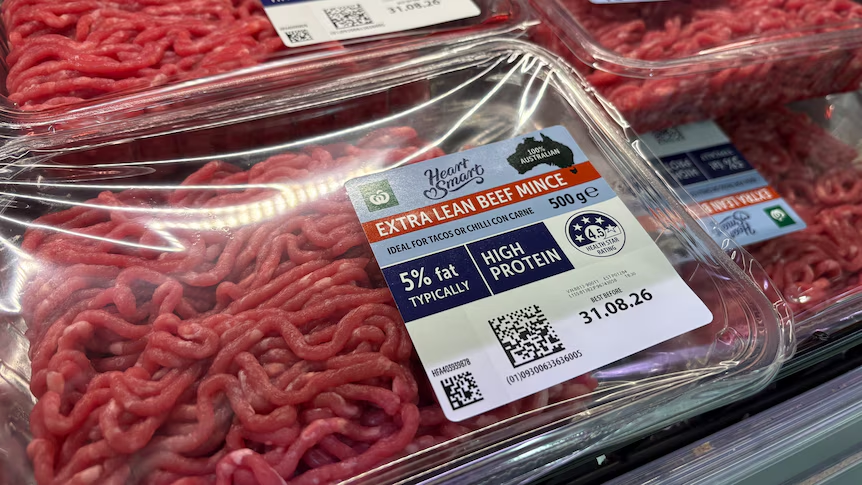
Photo: ZMO
All part of a larger agenda?
WOOLWORTHS LEAVES TASMANIA
Woolworths will stop selling Tasmanian-sourced beef in its supermarkets from 2027, it has been announced, bringing an end to a long-standing commercial relationship and raising fresh concerns about the future of the state’s beef industry.
The supermarket giant has told suppliers it will end its arrangement with JBS Foods’ abattoir at Longford, in northern Tasmania, citing “rising production and shipping costs”.

Woolworths is expected to continue buying Tasmanian beef until the end of 2026 before withdrawing from the market. The decision has particularly alarmed farmers, who valued Woolworths contracts as a reliable outlet for their cattle.
For some producers, the certainty provided by supermarket contracts has been important when making investment decisions and planning their businesses.

The underlying problem is bigger than the loss of one major customer.
Supermarkets have made it increasingly hard for the state’s meat-processing infrastructure to keep up with the evolving pace of the consumer market.
TasFarmers has argued that Tasmania lacks sufficient facilities capable of slaughtering, cutting, and packaging beef to the specifications required by major supermarkets.

As a result, cattle destined for Woolworths are slaughtered in Tasmania, but the carcasses are then transported across the Bass Strait to Victoria for further processing and packaging.
The finished beef is subsequently transported back to Tasmania for sale. The result is an expensive supply chain in which locally produced food crosses the Bass Strait twice.
A ridiculous process with the standards are so high that local industry can’t compete, as the shortage of smaller abattoirs also limits farmers’ ability to have cattle processed locally.
The supermarket says it will continue buying from Tasmanian suppliers in other categories, but nevertheless, the impact on the beef sector could be significant.
Coles already does not buy Tasmanian beef, meaning Woolworths’ withdrawal will leave farmers with fewer large-scale supermarket customers.
Local butchers have responded by urging Tasmanians to support producers directly.

The dispute exposes a striking paradox: a state renowned for its agricultural produce struggles to put locally grown food on local supermarket shelves at a competitive price.
Call me a ‘conspiracy theorist’, but it seems like this reality is done all by design.
Greater investment in local abattoirs and processing facilities could help break the cycle and avoid this situation, giving producers more markets while reducing the need to send Tasmanian meat to the mainland and back again. But they won’t do that.
They will just cut the region off completely, and with it, will go some of our best produce.
Something the ‘powers that be’ are more than happy to let happen, given the fact there has been a systematic break-down of our food supply chains targeting meat and poultry.
It would not surprise me if this decision if part of this larger agenda.
PHASING OUT MEAT
There has been a calculated effort to phase out current beef production standards for years now – something climate alarmists say is ‘contributing to warming of the planet’.
Let’s not forget that in 2023, the United Nations Food and Agriculture Organisation (FOA) released a ‘sustainable food roadmap’ that called on wealthy countries to cut back on meat and dairy – as it has become ‘unsustainable’ for the planet.
UN conference calls for food to be added to national climate plans
RELATED ARTICLE
A year later, this call became incorporated into our own national dietary advise here in Australia, with ‘experts’ warning of the ‘climate impacts’ of eating meat.
National dietary advice to now include ‘climate impacts’ of eating meat
RELATED ARTICLE
Academics insist the meat industry ‘needs to be overhauled’ if the world is to survive — and that current farming methods will not survive in the future.
Australians told to stop eating meat to ‘hit climate change targets’
RELATED ARTICLE
Would it be a surprise if somewhere, deep down in the decision-making process, this shift was factored in when Woolworths made this decision?
Instead of fighting for Australian industry, they are happy to see it burn to the ground.
They are also targeting the livestock itself with Big Pharma concoctions.
In January 2025, Denmark made it compulsory for conventional dairy farms to include Bovaer – the controversial additive – in cattle feed as part of their ‘climate plan’.
However, by the time a major U.K trial of this ‘net zero’ feed additive designed to ‘reduce emissions of planet-warming methane gas by dairy cows’ was underway, it abruptly ended, following controversy in Denmark and other regions over the health impacts on livestock.
Bovaer feed additive controversy rocks Europe, while Australia continues use
RELATED ARTICLE
This supplement can still be found on beef farms in Australia, like Coles Select suppliers.
You can find it used by Australian cattle farmers who produce Coles’ ‘carbon-neutral beef’, a range launched in 2023 and facing backlash on social media at the time.

The supermarket does not provide a detailed breakdown in public disclosures of exactly which suppliers, how many cattle, or what proportion of its beef comes from Bovaer-fed cattle. But the range is still available on their website for purchase:


According to reports, several Australian research institutions (CSIRO, University of New England, UQ, etc.) have studied Bovaer for use in beef cattle.

Our cattle have become lab-rat experiments for the ‘sustainable’ shift underway.
What do they want as a result? Lab-grown Frankenstein beef on our shelves.
Lab-grown meat cleared for sale in the United States
RELATED ARTICLE
Speaking of JBS Australia: This group announced they will be expanding their Bovilis MH+IBR vaccine mandate for angus cattle after ‘successful trials’ in NSW regions in 2025.
Requirement for JBS angus cattle to be vaccinated for feedlots expanding
RELATED ARTICLE
This is perhaps my only criticism of the Tasmanian industry, and moreso their leading abattoir: That this practice is likely being undertaken down there.
At least Woolworths customers won’t get those vaccinated lots on their shelves.
Despite the ill-advised decision making regarding livestock health, it is sad to see yet another blow to our farmers who have been doing it tough for decades.
It seems likely that many will shift to other products still imported to the mainland by the supermarket chains, like fruit for instance, leaving even less options for beef in the region.
I would love to see this decision create an opportunity for independent butchers to promote locally-sourced beef and strengthen links between farmers and consumers.
This would be a great opportunity for locals to take back control of their food supply chains.
But I may be a little too cynical of the direction the industry may head after this move.
What are your thoughts on all of this?
Be sure to leave your thoughts in the comment section below!

KEEP UP-TO-DATE
For more TOTT News:
Facebook — Facebook.com/TOTTNews
YouTube — YouTube.com/TOTTNews
Instagram — Instagram.com/TOTTNews
Twitter — Twitter.com/EthanTOTT
Rumble — Rumble.com/c/TOTTNews
Bitchute — Bitchute.com/TOTTNews
Gab — Gab.com/TOTTNews

People need to support small local suppliers…if they can.
There is no good reason to vax cattle (or livestock in general) for anything. My farm is vax-free: cattle, sheep, cat, me. Bovaer is/was a really dumb idea, like everything to do with the fake “global warming-climate change” narrative. Methane emissions from cattle (and CO2 of course) have no effect on world climate.